
S P E C T R E L L I S I N G B L O G | W I N E R Y O P E R A T I O N S The Bottling Evolution:
When and How to Scale Your Winery's Bottling Operation
Published by Spec Trellising | spectrellising.com | 1-800-237-4594
Every winery that grows eventually faces the same inflection point: the bottling line that launched your operation starts working against you. What began as a manageable afternoon for two people turns into a two-day production commitment that devours labor hours you don't have, at a consistency level that increasingly makes you nervous as your distribution expands.
The good news is that the bottling technology spectrum is broader and better than it's ever been— from smart semi-automatic systems ideal for boutique producers to fully automated SRAML monoblock lines that can transform a production-constrained winery into an operationally efficient one almost overnight. The question isn't whether to invest in better bottling equipment. The question is which technology is right for your volume, your product, and your five-year growth plan.
This post walks through that decision framework. For the full engineering detail—fill specifications, CIP system design, monoblock architecture, and ROI analysis formulas—we've published a companion Technical Reference Paper that digs considerably deeper into the mechanics.
Where Most Wineries Start: Gravity Fill and Counter Pressure Systems
If you're a boutique producer—say, under 5,000 cases a year—there's a very good chance your bottling operation started with a gravity filler, and there's nothing wrong with that. A properly specified gravity system gives you controlled, low-turbulence fills that respect delicate wine chemistry, a footprint that fits any winery facility, and an investment that makes financial sense at smaller production volumes.
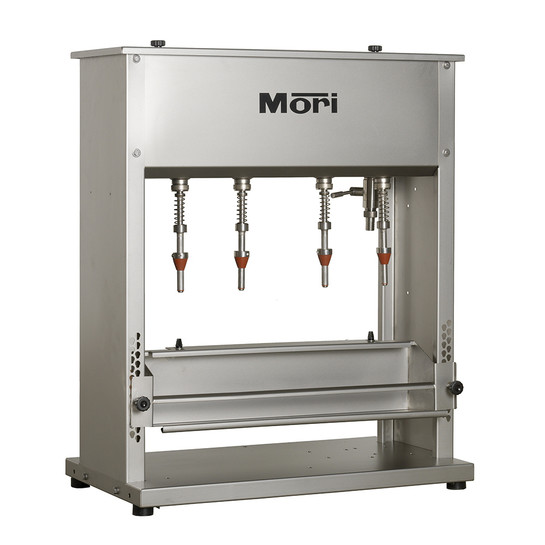
The Mori Gravity Filler Line
Spec carries the Mori semi-automatic gravity filler line—a family of AISI 304 stainless steel linear fillers in 4-nozzle and 6-nozzle configurations, compatible with 375ml through 1.5L bottles. The Mori design is respected worldwide specifically because it's simple where simplicity matters: nozzles disassemble in seconds for cleaning, the mechanical float system is reliable and straightforward to calibrate, and the AISI 304 construction holds up to the acid and sulfite chemistry of the winery environment indefinitely.
One meaningful advantage Spec offers with Mori equipment: we maintain active inventory and receive regular incoming stock. If you need a filler this season rather than next, we can make that happen. Automated SRAML systems, by contrast, are custom-engineered and carry longer lead times—which is entirely appropriate given what they do, but worth knowing as you plan.
Counter Pressure Filling for Sparkling Wines and Ciders
If any part of your production involves sparkling wine, pét-nat, cider, or other carbonated beverages, a gravity filler simply won't work—the pressure differential will cause immediate foaming and the resulting fills will be inconsistent, underfilled, and oxygen-saturated. You need a counter pressure system.
The Barida ISO4 Iso-Baric Counter Pressure Filler is our go-to recommendation for semi-automatic pressurized filling. It's a 4-spout system engineered to minimize dissolved oxygen through a multistage degassing cycle before any wine crosses the fill valve. Anti-foam nozzles direct the fill stream against the bottle wall rather than dropping it as a column—reducing foaming and improving fill consistency. It handles pressures up to 6 bar, works with crown caps, mushroom corks, and wire hooders, and sits on wheels for easy storage when not in use.
For wineries producing both still and sparkling wines, it's also worth knowing that Spec can configure hybrid bottling lines that accommodate both fill types on the same line—avoiding the cost and footprint of running two entirely separate setups.
Not sure which fill system is right for your products?
Our technical reference paper includes a complete evaluation matrix covering product type, production volume, capital budget, and cleaning requirements to help you match the right technology to your operation.
See the full Technical Reference Paperfor engineering specifications on both systems.
Recognizing the Signals: When Semi-Automatic Isn't Enough
The transition from manual to automated bottling isn't something you decide in a vacuum—your operation will tell you when it's time. Here are the signals that consistently show up before a winery makes the leap:
Bottling is Crowding Out Everything Else
When your bottling schedule has become a significant calendar constraint—when the winemaker is pulling double duty on bottling days, when tasting room hours get cut to accommodate a run, when harvest planning has to account for bottling backlog—you're past the point where manual systems are serving you. Automation is a labor recapture exercise as much as it is a throughput story.
You're Approaching 10,000 Cases
Ten thousand cases per year is widely cited as the practical threshold where manual bottling stops being viable. At that volume, the math on a dedicated bottling crew—fully loaded labor cost, benefits, turnover, training—typically justifies automated equipment within 2–3 years. Our technical paper includes an ROI calculation framework that lets you run the numbers against your specific cost structure.
Fill Consistency Is Becoming a Distribution Issue
If you're moving wine through wholesale channels, retail accounts, or restaurant programs, fill level consistency is no longer just a quality preference—it's a contractual expectation. Buyers notice.
Automated electronic dosing units maintain tolerances that are mechanically impossible to achieve consistently by hand.
You're Paying for Mobile Bottling
Mobile bottling services typically run $0.25–$0.50 per bottle in service fees. For a 20,000-bottle annual volume that's $5,000–$10,000 per year, every year, with zero equity accumulation and complete dependency on someone else's schedule. An in-house automated line that eliminates that dependency pays back measurably and reclaims your production timeline.
The Full Automation Threshold Analysis
Our technical reference paper covers all five bottling automation signals in depth, including production volume models, labor cost benchmarks, and quality consistency requirements by distribution tier.
SRAML Automated Bottling Lines: What Sets Them Apart
SRAML builds complete bottling systems—not components. Their monoblock architecture integrates rinsing, filling, and capping into a single synchronized unit with one control system, one footprint, and one service relationship. One SRAML customer captured the performance impact plainly: "The latest investment increased our production rate by at least 200%."
You may already know SRAML from their grape press line. Their pneumatic presses are among the most respected gentle-pressing systems in the industry, and Spec carries the full VP ECO, VP Standard, and VP Inertgas series. The same engineering commitment that makes those presses run reliably for 5+ years without drama extends through their entire product line, including the bottling systems.
Why Monoblock Architecture Matters
Legacy bottling lines were built from separate machines connected by conveyors—a rinser, then a filler, then a capper, each with its own motor and timing. The mechanical interfaces between machines are where timing drift, contamination risk, and maintenance headaches live. SRAML's monoblock eliminates all of that by executing every step within a single synchronized frame.
The practical results: a smaller footprint (often 30–40% smaller than an equivalent-capacity separate-machine line), fewer operators required, and fill-level consistency that comes from synchronized mechanical timing rather than hoping three independent machines stay in sync.
CIP: The Feature That Protects Your Investment
Every SRAML monoblock includes an integral Clean-In-Place unit. CIP runs hot water, acid, caustic, or sanitizer through all product-contact surfaces without disassembly—something that simply isn't achievable on manual or semi-automatic systems at the same throughput or reliability.
As wholesale distribution accounts become more sophisticated about food safety documentation, the ability to demonstrate CIP-capable bottling is increasingly a table-stakes requirement. It's a quality and compliance asset, not just a convenience.
Custom Engineering—Spec Manages the Process
SRAML systems aren't off-the-shelf—they're specified to each winery's production volume, facility dimensions, electrical service, closure types, and growth projections. Spec Trellising manages the entire consultation and project coordination process directly with SRAML's engineering team, so you're not navigating an overseas manufacturer alone.
The technical reference paper covers the SRAML product architecture in full detail, including monoblock ECO vs. STANDARD series, conveyor integration options, and facility planning requirements.
Planning Your Bottling Evolution: A Phased Approach
You don't have to jump from a 4-nozzle gravity filler to a full automated monoblock in one move. For most wineries, a phased approach is both financially smarter and operationally more manageable:
- Phase 1: Establish your semi-automatic foundation with a Mori gravity filler or Barida ISO4 counter pressure filler. Build production protocols and collect throughput data.
- Phase 2: Add a semi-automatic labeler and capsule applicator to reduce post-fill labor. Identify your actual bottleneck.
- Phase 3: Commission a SRAML automated monoblock sized for 3–5 year projected production volumes. Transition your semi-automatic equipment to small-run or backup duty.
Each phase builds on the last. And each phase generates the operational data—cases per shift, labor hours per run, fill rejection rates—that makes the ROI case for the next investment defensible rather than speculative.
The full technical reference paper includes a complete ROI calculation framework for bottling automation, including labor savings models, throughput capacity projections, and a comparison of in-house automation versus continued mobile bottling contracts.
Spec Trellising: Equipment for Every Stage of the Journey
Whether you're setting up your first bottling operation or evaluating an automated line for a production facility that's outgrown its current setup, Spec has the equipment and the expertise to match you with the right solution. Our Winery Supplies & Equipment catalog covers the full production workflow, and our team has hands-on experience with every product we carry.
For semi-automatic bottling needs, explore our Bottling & Packaging category—including Mori gravity fillers, Barida counter pressure fillers, bottle rinsers, corkers, cappers, and disgorgers, most available from stock. For SRAML automated line projects, contact us directly to begin the consultation process.
Ready to Talk Bottling Equipment?
Call us at 1-800-237-4594, email info@spectrellising.com, or browse our complete winery equipment catalog at spectrellising.com. Our team is ready to help you find the right bottling solution for where you are today—and where you're headed.
About the Author
Technoid Tom serves as the Information Technology Officer at SpecTrellising and CEO of Technoid Computer Group (technoidcomputer.com). With multiple university science degrees and years of experience in complex technical systems, Tom has recently discovered his passion for viticulture and enology (the science of winemaking).
His unique background allows him to bridge cutting-edge vineyard technology with practical agricultural applications. Through his work at SpecTrellising, Tom has gained hands-on experience with trellising systems and engineering challenges facing modern commercial vineyard operations. He applies data-driven methodologies and scientific analysis to optimize vineyard infrastructure, bringing a distinctive analytical perspective to traditional vineyard practices.
Connect with Technoid Tom and the Technoid Computer Group at technoidcomputer.com for technology solutions, or reach out through SpecTrellising at info@spectrellising.com for vineyard trellising expertise.