
How Much of Your Grape Harvest Can Birds and Insects Actually Destroy?
For commercial vineyard operators, the answer is sobering. Research shows unprotected grape crops can lose up to 95% of their crop to bird damage by late October, while white varieties typically suffer around 60% loss (Somers & Morris, 2002). In California alone, more than 67% of vineyard acres already experience some degree of bird damage every season.
And the pressure is rising. As warming temperatures shift migratory patterns and concentrate bird populations in agricultural areas, the window for protecting your fruit keeps narrowing. Insect pressure follows the same trend. The question for the 2026 season isn't whether your vineyard faces these threats — it's whether you'll have physical protection in place before veraison, when sugar levels rise and your fruit becomes a target.
This guide explains what works, what to look for in vineyard netting, and how to choose between the three permanent-style netting systems available exclusively from Spec Trellising.
Why Is Bird and Insect Pressure Getting Worse?
Bird damage is immediate and visible — flocks descend, and within days a block can be stripped. Insect damage is slower but compounds across the whole season. Both are intensifying for the same underlying reason: a warming climate is changing how and when pests feed.
- Warming temperatures accelerate insect reproductive and metabolic rates, producing more generations per season.
- Research predicts that a 2°C temperature increase could drive a 31% increase in crop losses to insect pests (Deutsch et al., 2018).
- The overwintering range of agricultural pests is expanding, so problem insects survive in regions that once killed them off each winter.
- The American grapevine leafhopper is moving northward, carrying the risk of Flavescence dorée — a serious grapevine disease — into new growing regions.
Grape berry moths, leafhoppers, Japanese beetles, mealybugs, and the Multicolored Asian Lady Beetle (MALB) all threaten fruit quality — and MALB in particular can taint an entire lot of wine if it reaches the crush.And a newer threat is spreading fast — the spotted lanternfly, now confirmed as far south as South Carolina. For the full data and citations, download our Spec Trellising Bird and Insect Netting Report.
What's the Most Reliable Way to Protect a Vineyard?
Chemical interventions have their place, but they require repeated application, face tightening regulation, and do nothing to stop birds. Physical barriers — quality netting — remain the most reliable and environmentally sustainable protection available. A permanent-style netting system installed once protects against both acute bird damage and chronic insect pressure for years, while reducing chemical use and improving fruit quality through more consistent ripening.
The key is choosing netting engineered for the job: the right mesh size to exclude both birds and target insects, enough weight and material quality to last more than a season, and reinforced construction that survives wind, sun, and repeated deployment.
Does Netting Stop the Spotted Lanternfly?
Yes. The spotted lanternfly has spread rapidly through East Coast grape country and is now confirmed as far south as South Carolina, and it's a direct threat to vines — feeding on sap, weakening vines, and coating fruit and leaves in honeydew that fuels sooty mold.
Because adult lanternflies are large insects, a properly engineered vineyard mesh physically excludes them. Spec growers are already draping our netting specifically for lanternfly protection, with strong results. This is one reason mesh dimension matters: a net tight enough to stop birds and fine enough to block lanternfly adults gives you layered protection from a single system.
How Do You Keep Yellowjackets and "Ground Hornets" Off Your Grapes?
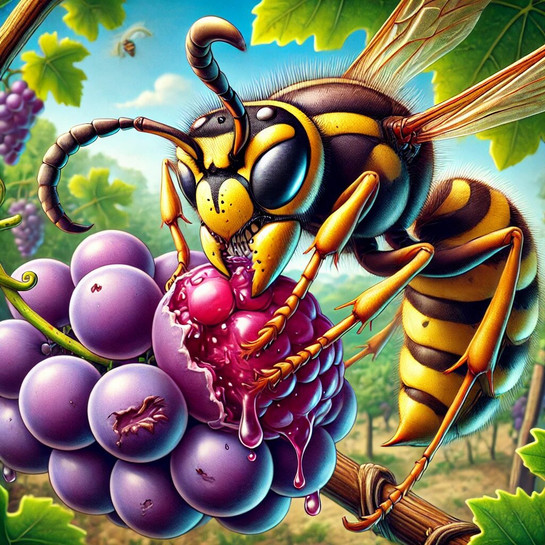
Ground-nesting yellowjackets — often called "ground hornets" — are one of the most frustrating harvest pests a grower faces. They feed on ripening clusters, open the door to bunch rot and sour rot, and sting crews during picking. And here's what most growers don't realize: there are no insecticides labeled for use against social wasps in vineyards. You cannot legally spray your vines to kill them.
That makes physical exclusion one of the only effective, legal defenses available — and it works. One of our growers in Ohio is in his third season protecting his fruit with Spec netting, staking the net tight to the ground along the row so the wasps can't get underneath and up into the canopy. It's a simple technique that turns a drape net into a near-complete barrier against a pest you otherwise can't treat.
What Mesh Size Stops Both Birds and Insects?
This is where most generic agricultural netting falls short. Wide-mesh bird netting stops birds but lets insects through. True dual-protection netting uses a tight, precisely engineered mesh. The three systems below were developed specifically for premium vineyard and winery protection — and each is proprietary to Spec Trellising, manufactured exclusively for us and available from no other source.
TightLoch®, CrystaLoch®, and IceVine®: Which Spec Trellising Netting Is Right for You?
All three are registered trademarks of Spec Trellising, made to our specification by our manufacturing partners. No other distributor is authorized to sell them. Here's how they compare:
|
Product |
Weight |
Mesh |
Best For |
Standout Feature |
|
TightLoch® |
50 GSM |
3mm × 5mm triangular |
Maximum dual bird + insect protection |
10-year warranty, ~13-year typical lifespan — the gold standard |
|
CrystaLoch® |
40 GSM |
2mm × 7mm rectangular |
Strong protection with maximum airflow |
100% virgin HDPE cylindrical monofilament, reinforced edges |
|
IceVine® |
Extra heavy |
Heavy reinforced mesh |
Ice wine & premium wine grapes; high-pressure sites |
Load-bearing reinforced edges + center, high puncture resistance, MALB protection |
TightLoch® Permanent Style Side Netting
Our flagship. At 50 GSM with a 3mm × 5mm triangular mesh, TightLoch® is engineered to exclude both birds and insects while still allowing the airflow and sunlight your canopy needs. With a 10-year warranty and a typical lifespan of around 13 years, it's the longest-term protection we offer. View TightLoch® »
CrystaLoch® Permanent Style Side Netting
At 40 GSM with a 2mm × 7mm rectangular mesh, CrystaLoch® maximizes airflow while still delivering excellent protection. Made from 100% virgin HDPE cylindrical monofilament with reinforced edges, it's built for durability in demanding conditions. View CrystaLoch® »
IceVine® Permanent Grapevine Netting
Purpose-built for both ice wine and conventional wine grape protection, IceVine® uses an extra-heavy mesh with load-bearing reinforced edges and center reinforcement. Its high puncture resistance and protection against insects including MALB make it the choice for premium producers who can't risk a tainted lot. View IceVine® »
The Complete Spec Trellising Netting Lineup
Beyond our three exclusive dual-protection systems, Spec carries the East Coast's deepest netting selection — matched to your trellis type, pressure level, and budget. Every net is knitted from UV-stabilized material and carries a 10-year pro-rated UV warranty.
|
Product |
Application |
Weight |
Mesh |
Protects Against |
Notes |
|
Permanent side |
50 GSM |
3mm × 5mm triangular |
Birds, insects, wasps, deer |
Lives on the trellis ~13 yrs; allows airflow + spray penetration. The gold standard. |
|
|
Permanent side |
40 GSM |
2mm × 7mm rectangular |
Birds + insects |
100% virgin HDPE monofilament, reinforced edges, maximum airflow |
|
|
IceVine® ★ |
Permanent side |
Extra heavy |
Heavy reinforced |
Birds + insects incl. MALB |
Reinforced edges + center; ice wine & premium grapes |
|
ZoneNet (Non-Permanent Side) |
Removable side |
Lightweight |
15mm triangular |
Birds (light pressure) |
Economical; on/off each season. Best for low-pressure sites; not rated for deer |
|
Drape-over |
Knitted |
5/8" (15mm) hex |
Birds |
Widths 16.5' & 21.5'; white/black/green; heavy-duty storage bag included |
|
|
Drape-over |
30 GSM (heavier as special order) |
Classic hex |
Birds + excellent deer |
Covers several rows at once (33'–66' wide); allows sun, airflow & bees; storage bags included |
|
|
Drape-over |
50 GSM |
3mm × 5mm |
Birds + insects |
The drape option that also stops insects — a fine-mesh size of the Classic single-row drape |
★ = proprietary to Spec, sold nowhere else.
Which type fits your trellis? High-wire, GDC, or Lyre systems → single- or multi-row drape-over. Vertical systems (VSP, Scott-Henry, Smart-Dyson) → either drape-over or side netting hung from the catch wires to cover the fruit zone. For high bird pressure, smaller-aperture nets (TightLoch) protect fruit far better than wide hex mesh.
Does Vineyard Netting Pay for Itself?
The economics are straightforward. When bird damage alone can take up to 95% of an unprotected crop, the return on quality netting is measured in saved harvests, not years. Beyond preventing loss, permanent netting delivers:
- Protection from both sudden bird damage and season-long insect pressure
- Reduced need for chemical interventions
- Improved grape quality through consistent, uninterrupted ripening
- Multi-year protection from durable, reinforced materials
- Substantial labor savings from permanent, reusable installations
Because we import these systems directly and sell them factory-direct, you get premium protection with no added import fees — the lowest pricing available on netting you genuinely cannot buy anywhere else.
When Should You Install Vineyard Netting?
Before pressure peaks — not during it. The most effective protection goes up ahead of veraison, before sugar levels make your fruit a target and before migratory flocks arrive in force. Every season we hear from growers who waited and watched a block disappear in a matter of days. Early protection is the difference between a managed cost and a lost harvest.
Contact Spec Trellising today at 1-800-237-4594 to discuss your vineyard's specific protection needs, or browse our full bird netting & wildlife control range. Our team can help you match the right netting system to your site, your varieties, and your pressure level.
Download the complete Spec Trellising Bird and Insect Netting Report for the full analysis and scientific citations.
References:
Deutsch, C.A., et al. (2018). Increase in crop losses to insect pests in a warming climate. Science.
Kross, S.M. (2015). Insect pest control and bird damage as a function of distance from riparian habitat in a California vineyard. University of California.
Somers, C.M., & Morris, R.D. (2002). Birds and wine grapes: foraging activity causes small-scale damage patterns in single vineyards. Journal of Applied Ecology, 39, 694–705.
About the Author
Technoid Tom serves as the Information Technology Officer at Spec Trellising and CEO of Technoid Computer Group. With multiple university science degrees and years of experience in complex technical systems, Tom has discovered a passion for viticulture and enology (the science of winemaking).
His background lets him bridge cutting-edge vineyard technology with practical agricultural application. Through his work at Spec Trellising, Tom has gained hands-on experience with trellising systems and the engineering challenges facing modern commercial vineyard operations, applying data-driven methods and scientific analysis to optimize vineyard infrastructure.
Connect with Technoid Tom and the Technoid Computer Group at technoidcomputer.com for technology solutions, or reach out through Spec Trellising at info@spectrellising.com for vineyard trellising expertise.